In brief
Gutiérrez's groundbreaking ideas reshaped Church doctrines, sparking both support and controversy within the Catholic faith, where he was celebrated for his compassion towards the poor but criticized for perceived Marxist leanings.
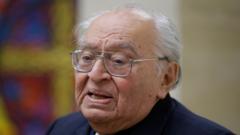
Father Gustavo Gutiérrez, the influential Peruvian priest credited with establishing liberation theology, has passed away in his hometown of Lima at the age of 96. This movement, which encourages active engagement from the Roman Catholic Church in addressing poverty and social injustices, has garnered both accolades and criticism globally. The priest's seminal work, "Theology of Liberation," published in 1971, fundamentally altered Church teachings, resonating with many across Latin America while facing pushback from conservative factions within the Church, including Cardinal Joseph Ratzinger, who later became Pope Benedict.The discord centered mostly around allegations that Gutiérrez's frameworks bordered on Marxism, which some, including Ratzinger, deemed a threat to Church integrity. However, relations improved notably after Jorge Mario Bergoglio ascended to the papacy as Pope Francis. Gutiérrez received heartfelt recognition from Pope Francis, who admired his commitment to establishing "a poor Church for the poor," even sending him a letter of gratitude on his 90th birthday, applauding his contributions to the Church and the marginalized sectors of society.Before his clerical journey, Gutiérrez had diverse educational pursuits, studying medicine, literature, philosophy, and theology across multiple countries, which profoundly influenced his theological approach. Critics often labeled him as a communist due to his focus on uplifting the impoverished, a sentiment that was magnified when radical priests associated with liberation theology took part in revolutionary efforts, such as supporting the Sandinistas in Nicaragua.Despite such controversies, Gutiérrez asserted that his teachings remained firmly grounded in biblical insights rather than revolutionary agendas. Upon returning to Peru, he noted the disconnect between Church leaders and their communities, urging that clergy learn from the resilience exhibited by the churchgoers from impoverished neighborhoods. He rejected the prevailing narrative that life was meant for suffering, famously stating, “No one is born to suffer, but to be happy," highlighting poverty as a construct of human society.Described as a humble figure with a profound connection to his community, Gutiérrez seamlessly blended his roles as a distinguished theologian and a practical parish priest. His impact was felt deeply by many, with Peruvian sociologist Félix Grández reflecting on the priest's joyful spirit and ability to relate complex theological concepts in accessible ways. Gutiérrez's legacy endures through his striking ability to connect spirituality with everyday life, supported by a love of music, cinema, and football, which made him relatable to his parishioners.