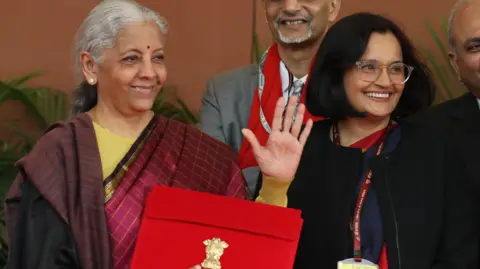
India's Finance Minister Nirmala Sitharaman has presented her annual budget for 2026-27, announcing higher infrastructure spending and measures to support domestic manufacturing amid rising global uncertainties.
India is expected to close this financial year with 7.4% gross domestic product (GDP) growth according to the country's Economic Survey, but economic expansion will slow slightly next year as US President Donald Trump's 50% tariffs on Indian exporters start taking a greater toll.
The budget has laid a strong emphasis on fiscal restraint, targeting a lower deficit for the upcoming financial year. The fiscal deficit is the gap between the government's total expenditure and its total revenue.
Record infrastructure spending, higher defence outlays
Infrastructure such as road, port and railway projects has been a mainstay focus of the Narendra Modi government for the past decade, and this budget continues to expand allocations to these sectors.
The capital spending target for the upcoming financial year beginning 1 April has gone up some 9% to 12.2tn rupees ($133.1bn; £105bn) from 11.1tn rupees.
Outlays for defence have also jumped by over 20% in the backdrop of heightened geopolitical tensions globally.
Manufacturing push in strategic sectors like rare earths, semiconductors
The government has proposed to scale up manufacturing in seven strategic sectors including semiconductors, data centres, textiles and rare earths, amid slowing private investments and a flight of foreign capital from India.
Sitharaman announced that dedicated corridors will be set up for rare earth minerals in four states, including Tamil Nadu, Kerala and Andhra Pradesh in the south and Odisha in the east. The announcement follows India's approval of a 73bn-rupee rare earths scheme unveiled in November.
The budget also launched a second semiconductor mission with an outlay of $436m to produce equipment and materials and design full-stack intellectual property.
India is also proposing a tax holiday up to 2047 for foreign cloud companies making data-centre investments in the country and providing cloud services to customers globally. This provides long-term fiscal certainty for a highly capital-intensive sector, significantly improving investment viability and accelerating capacity creation, said Ritika Loganey Gupta of Ernst & Young India.
The budget has also announced new mega-textiles parks to enhance India's exports competitiveness in the labour-intensive garments industry - expected to benefit from greater global market access following last week's India-EU free trade agreement.
No new tax giveaways
Amid slowing exports because of US tariffs, India has proposed raising limits on duty-free inputs for industries such as seafood, which are major export sectors. Customs duty exemptions have also been allowed for inputs used to manufacture lithium-ion batteries.
But no direct tax cuts have been announced on personal incomes. This was expected as Modi's government had raised income tax exemption limits last year, making earnings of up to 1.2m rupees - excluding special rate income like capital gains - entirely tax-free.
Markets disappointed
Despite strong signalling on fiscal discipline, the financial markets fell sharply as the Securities Transaction Tax (STT) on futures and options trading was raised. Coming on top of last year's hike, this is likely to raise impact costs for traders, hedgers and arbitrageurs. This could cool derivative activity and lead to a reduction in volumes, said Shripal Shah, managing director and CEO of Kotak Securities.