In brief
Senator Thorpe's protest highlights ongoing tensions regarding Britain's colonial past and its impact on Indigenous Australians, raising crucial questions about sovereignty and representation.
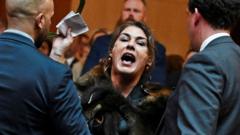
Australian lawmakers have formally condemned Senator Lidia Thorpe for her vocal protest directed at King Charles during his recent visit to Canberra's Great Hall. The Senate voted 46-12 to censure the Aboriginal senator after she interrupted the King's address by shouting "you are not my King" and "this is not your land," aiming to draw attention to the legacy of British colonization. While the censure represents a significant act of political disapproval, it holds no binding legal implications regarding her position.Immediately after the session, Thorpe expressed her frustration to reporters about being unable to respond in the chamber due to a delayed flight, reiterating her stance that the Crown has committed "heinous crimes" against Indigenous Australians. Thorpe's actions received mixed reactions; while many in the political arena and some Indigenous leaders condemned her outburst, several activists lauded it as a shining light on the struggles of the first peoples of Australia. They underscored continuing socio-economic disparities faced by Aboriginal and Torres Strait Islander communities in comparison to non-Indigenous Australians.The controversy surrounding Thorpe's heckling comes against the backdrop of long-standing calls for a treaty that recognizes Australia's Indigenous peoples—a development not realized unlike many other former British colonies. Many Indigenous Australians assert that they never surrendered their sovereignty or land rights. Despite the protest, the royal couple, King Charles and Queen Camilla, enjoyed warm receptions during their week-long tour of Australia. Reflecting on the visit, Prime Minister Anthony Albanese acknowledged the complexities of Australia's relationship with the crown while emphasizing respect for the Australian populace.Thorpe, a passionate advocate for Indigenous rights, made headlines in 2022 when she labeled Queen Elizabeth II a colonizer during her swearing-in ceremony, a remark that led to calls for her to retake her oath. Last year, Australia faced a significant setback when a proposal to grant constitutional recognition to Aboriginal and Torres Strait Islander peoples was emphatically rejected in a referendum known as the Voice. While evidence suggests many Aboriginal people supported the initiative, it was met with considerable skepticism, including from Thorpe, who viewed it as merely symbolic.