In brief
Yoon Suk Yeol's attempts to exploit historical anxieties about communism have led to a resurgence of far-right conspiracies in South Korea. As he faces impeachment, his supporters rally around fears of a leftist takeover fueled by propaganda about North Korean infiltration.
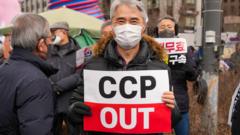
On a frigid January afternoon, a young pharmacy student named Shin Jeong-min stood outside South Korea's Constitutional Court, awaiting the arrival of suspended President Yoon Suk Yeol as he fought to overturn his impeachment. With hundreds of ardent supporters voicing their discontent, they chanted, "Release him now. Cancel his impeachment." Jeong-min expressed her concern, reflecting a belief widespread among Yoon's supporters: that a left-leaning opposition party harbors intentions to unify with North Korea, ultimately transforming South Korea into a communist state.At just 22, Jeong-min contrasts sharply with older generations, who lived through the Cold War and retain a deep-seated mistrust of the North. These fears were played upon during Yoon's attempt to declare martial law in December, wherein he suggested that "North Korean communist forces" had infiltrated the opposition, necessitating strict government measures to eliminate dissent. Now, months later, there is a palpable anti-communist fervor among Yoon's supporters, some of whom previously hadn't considered the North's threat but are now convinced a leftist dictatorship lurks on the horizon."This is a battle between communism and democracy," declared one office worker in his 40s who participated in the protests outside the court. As Yoon's supporters rallied, many argued he should be reinstated as the sole means of confronting North Korean agents, recalling earlier decades when actual North Korean infiltration was common.Sociology Professor Shin Jin-wook observes that anti-communism has historically been used by South Korea's military dictators to justify restrictive measures against the populace. Though contemporary threats from Pyongyang pose challenges, the electorate is fundamentally divided over engagement versus military deterrence.Critics accuse Yoon of manipulating these historic fears for political gain, comparing his tactics to those of past authoritarian leaders who vilified opponents as agents of the North. One opposition lawmaker, Wi Sung-lac, asserts that claims of Chinese interference in last year's election are fabricated, designed to discredit opposition forces.Polling expert Lee Sangsin notes that while extreme anti-communist sentiments were once relegated to fringe groups, Yoon's presidency has given such narratives a hearing among greater numbers. Many supporters, previously indifferent to political ideologies, now view Yoon's martial law as a necessary measure to combat deep-rooted leftist influences in society.Supporters frequently cite moments from history, such as previous Democratic leadership aimed at fostering relationships with North Korea, as confirmation of a conspiratorial narrative. Meanwhile, scepticism towards institutions central to democratic governance is rising, leading to a dangerous destabilization of trust.Despite many observers still desiring Yoon's ouster, his popularity appears to have stabilized as the narrative around threats evolves. Increasingly, public opinion is turning against China, with many supporters declaring it a looming menace behind South Korea's political strife.Young adults with little concrete experience of North Korea now view China through a lens of suspicion. Experts argue that such fears are exaggerated, attributing their rise to contemporary grievances rather than historical Communist antagonism. Despite Yoon's attempts at sustaining paranoia, there remains a substantial segment of the population yearning for balance and steadiness in governance. Critics caution against the polarizing influence of Yoon's tactics, noting that the fallout from his presidency will likely echo in South Korean society for years to come.