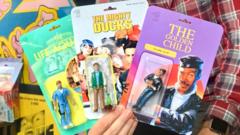
In a rapidly evolving digital landscape, a growing number of artists and creatives are voicing their discontent over the proliferation of AI-generated doll images. These visual representations are generated with the help of artificial intelligence, creating what many call "starter packs" of individuals as action figures, but their rise has become a battleground for artistic integrity and livelihood.
Since early April, the phenomenon has seen countless individuals sharing personal photos to have AI transform them into doll forms. However, this surge has raised significant concerns about privacy, the environment, and the devaluation of authentic artistic creation.
Nick Lavellee, a seasoned custom action figure maker, expressed his apprehension regarding the saturation of AI-generated artwork on social media. Having crafted figures for various notable personalities, he feels that the aesthetic value of traditional hand-made art is at risk. "People are sick of them. It's an artistic aesthetic - AI-generated art diminishes that," Lavellee shared about his experiences of navigating the charge in consumer preferences.
The #StarterPackNoAI movement, which launched on Instagram in April, has gained considerable traction, drawing attention from other artists like Maria Picassó Piquer. She participated not only for enjoyment but as a statement on the importance of human creativity. Her observations highlighted the uniformity in AI artwork, contrasting it with the diverse expressions found in human-created pieces, which are rich in personal flair.
Moreover, illustrators like Dav le Dessineux have reported losing contracts to AI-generated designs, leading to a sense of frustration spreading across the art community. For him, the instruments of true artistry are simple: "all you need to start being an artist," he insists, are basic tools like a pencil and paper.
Artists in various locales, including Eli Dibitonto from Italy and Evie Joyce from the UK, echoed similar sentiments about the intrinsic meaning embedded in their creations compared to AI outputs. They argued that art should be a reflection of individuality and life experiences, something AI cannot replicate authentically.
While some, including Lavellee, acknowledge the potential utility of AI as a tool in the creative process, they lament the industry’s trajectory toward mass-produced creations lacking genuine emotion. Henk van Ess, a global expert in AI research, criticizes the current trend of generating simplistic visuals instead of utilizing the technology to address pressing global issues.
Despite these challenges, Nick Lavellee maintains hope for the future of art. He remains confident that discerning audiences will continue to value the irreplaceable essence of handcrafted art over computerized iterations. His perspective reflects a broader desire among artists to cultivate a deeper appreciation for human-made creations amidst the chaos of the digital age. In his words, "I really hope people are totally sick of AI action figures. But I hope they are smart enough to understand the difference between something that I'm doing versus what is computer-generated."
As the debate over AI-generated content continues, artists reaffirm their dedication to preserving the authenticity and individuality of their craft, encouraging a return to the value of human touch in art.