
In brief
The recently signed treaty between Russia and Iran establishes a robust military partnership aimed at mutual security and energy collaboration, with significant implications for global geopolitics.
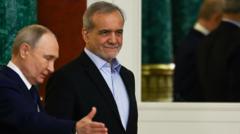
Russia and Iran are taking significant steps to deepen their military collaboration, a move underscored by the signing of a comprehensive 20-year "strategic partnership" treaty during a visit by Iranian President Masoud Pezeshkian to Moscow. This agreement encompasses various domains including defense, technology, energy, and trade, reflecting both nations' commitment to bolster their ties amid evolving global dynamics.Under this treaty, Russia and Iran agreed to consult on military and security threats and to engage in joint military exercises both on their own territories and elsewhere. The statement from the Iranian leadership marked the occasion as the beginning of a promising new chapter in Russo-Iranian relations. Notably, Iran has been supplying drones to Russia, along with ballistic missiles, as indicated by Western intelligence assessments.Trade prospects between the two nations could greatly improve, particularly through enhanced cooperation in the energy sector. During a joint press conference, Russian President Vladimir Putin highlighted plans for Russia to potentially construct new nuclear power units in Iran. Additionally, in light of decreased gas imports to the EU resulting from the Ukraine conflict, Russia is looking to expand its customer base by selling surplus gas to Tehran.Negotiations are also ongoing regarding a proposed gas pipeline connecting Russia and Iran, which, if realized, would traverse through Azerbaijan, as reported by Interfax, citing Russian Energy Minister Sergei Tsivilev. This strategic move could allow Russia to supply as much as 55 billion cubic meters of gas annually to Iran, reinforcing the intricate ties between the two nations.
