
In brief
The recent EU-China summit highlights a pivotal moment in their relationship, with concerns over trade imbalances and geopolitical tensions amidst the ongoing Russia-Ukraine conflict.
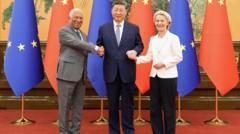
European Commission President Ursula von der Leyen recently characterized the state of EU-China relations as reaching an "inflection point" during a summit in Beijing with Chinese President Xi Jinping. She highlighted an imbalance in trade, specifically mentioning the European Union's substantial trade deficit with China. Von der Leyen cautioned that China's alignment with Russia is increasingly influencing its relationship with the EU.Xi Jinping responded by urging EU leaders to "properly manage differences," asserting that the challenges facing Europe do not stem from China. Despite previous suggestions that a change in U.S. leadership might ease tensions, relations between the EU and China have been strained of late.During the summit, which was shortened to one day at China's request, both leaders were urged to seek "real solutions" to their divergence of interests. Von der Leyen remarked on the importance of mutual acknowledgment of concerns. Xi echoed this, insisting that successful competitiveness would not come from isolation or severing supply chains.The backdrop to their discussions is the EU's looming €305.8 billion ($360 billion) trade deficit with China, a figure that has escalated significantly over the past decade. The EU has raised objections to China's industrial overcapacity, and as a result, it has implemented tariffs on Chinese electric vehicles. Conversely, after facing EU restrictions on its medical equipment, China retaliated by restricting government purchases of EU medical devices.A point of contention during the summit was China's perceived support for Russia amidst the Ukraine war. Von der Leyen urged China to leverage its influence over the Kremlin to work towards resolving the conflict, marking this issue as critical to future relations. The EU's imposition of sanctions on Chinese banks for aiding Russia further complicated the dialogue, as Beijing expressed discontent through formal channels.The atmosphere surrounding the meeting was described as tense, with observers noting a decline in trust between the EU and China. As relations reach a low point, the mediation of international conflicts, such as the one in Ukraine, coupled with trade fraught with tariff tensions, will significantly shape the EU-China dynamic moving forward.In conclusion, while both sides aspire to a balanced cooperative future, the path is fraught with challenges. The outcome of the summit may ultimately define the trajectory of EU-China relations for years to come.

