In brief
The steep drops across markets highlight both the immediate impact of trade tensions and fears of an upcoming recession in the U.S., which could further dampen Asian exports.
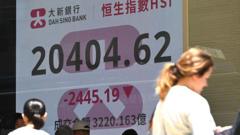
Asian stock markets experienced a historic plunge on Monday, demonstrating intense vulnerability to external trade dynamics and geopolitical tensions after President Donald Trump announced a new set of tariffs. From Shanghai to Tokyo and Sydney to Hong Kong, stocks plummeted to levels not witnessed in decades. At one point, the Shanghai Composite index dropped over 8%, Hong Kong's Hang Seng initiated a staggering decline of over 13%, and Japan's Nikkei 225 closed down by 7.8%. Analysts have labeled this downturn as a "bloodbath."The ripple effect of Trump’s tariffs has also reached European markets, where trading commenced with significant declines, particularly impacting banks and defense firms. This downturn follows a prior week of global market turmoil in response to Trump's announcement of tariffs ranging from 10% to 46% on numerous countries. Such steep tariffs pose a severe challenge for Asia's manufacturing economies that depend heavily on the U.S. for exports, spanning various sectors including textiles and automobiles.Countries like Japan and South Korea will be subjected to 26% tariffs, while developing nations such as Vietnam may face a 46% levy, with Trump designating it as one of the "worst offenders." Other nations such as Cambodia (49%), Thailand (36%), and China, which is bracing for a total of 54% tariffs, are also included in this daunting list. Countries like Singapore, New Zealand, and Australia are already grappling with an initial 10% tariff."Asia is bearing the brunt of the U.S. tariff hike. While there could be some room for negotiation, a new regime of higher tariffs is here to stay," stated Qian Wang, Asia-Pacific chief economist at Vanguard, an investment firm. The ecosystem is particularly sensitive as the possibility of a global trade war escalates fears of a U.S. economic slowdown or recession, which would further diminish Asian exports reliant on American markets.As markets opened after public holidays, slumps in mainland China, Hong Kong, and Taiwan were exacerbated. The Shanghai Composite ultimately closed 7.3% lower, with Taiwan's Weighted Index recording a historic drop of 9.7%. Australia’s ASX 200 index declined by 4.2%, while South Korea's Kospi fell by 5.6%. The Hang Seng's closing percentage marked its highest decrease since 2008."This turmoil around tariffs directly feeds into economic expectations surrounding inflation and a looming recession," remarked Julia Lee, head of client coverage at FTSE Russell, an affiliate of the London Stock Exchange. Following Trump's announcement, Goldman Sachs has raised the likelihood of a U.S. recession within the next year from 35% to 45%, with JPMorgan amplifying this outlook to a 60% chance of a downturn globally and domestically.Countries reliant on U.S. markets, such as Vietnam and Bangladesh, whose economies are heavily intertwined with American consumer demand, are on high alert. Brands like Nike and Gap manufacture in Vietnam, and Bangladesh exports approximately $8.4 billion annually in garments to the U.S.Frank Lavin, a former U.S. undersecretary for international trade, noted that "Asia will feel a disproportionate impact, as the region sends more exports to the U.S. compared to other markets." As tensions escalate further, China has retaliated with its own tariffs on U.S. goods, fueling ongoing global stock market disturbances.The previous week saw the U.S. stock markets decline over 5%; the S&P 500, for instance, witnessed a nearly 6% fall, marking the worst week since 2020. The FTSE 100 in the UK also saw a decline of almost 5%, indicating similar trends across European markets including Germany and France. Traders anticipate continuing struggles, as data from U.S. futures suggests a challenging session ahead on Wall Street. Global stock markets have collectively lost trillions since Trump's tariff announcements, with products worldwide facing alarming rate increases due to the newly imposed tariffs.