In brief
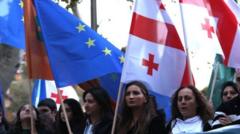
In a crucial election, Georgian opposition parties are framing the vote as a vital decision for the country's future between aligning with Europe or succumbing to Russian influence. While the ruling party, Georgian Dream, contradicts this narrative, the scars of past conflicts with Russia loom over voters as they seek a path towards European Union membership.
Georgia stands at a crossroads as it prepares for a significant election, where the choice is presented as a pivotal moment between aligning with Europe or returning to Russia's influence. The tensions remain palpable for many Georgians, reminiscent of the five-day war in August 2008 when Russian forces invaded the country, leaving deep scars and memories of conflict, particularly in regions like Gori and Shindisi.In the lead-up to the vote, opposition groups have united to challenge the ruling Georgian Dream party, accusing it of veering towards Moscow and neglecting Georgia's aspirations for EU membership. Mindia Goderdzishvili, spearheading the campaign for the Coalition for Change in Gori, emphasized the emotional toll of the past conflicts, arguing that the government exploits these memories to maintain its hold on power.Conversely, the Georgian Dream party, led by billionaire Bidzina Ivanishvili, dismisses the opposition's framing, presenting itself as the true guarantor of peace. They label the opposition as agents of a "global war party" intent on dragging Georgia into another conflict. Despite promises to guide Georgia towards EU membership by 2030, many citizens express skepticism, especially in light of recent anti-LGBT laws and the EU's hesitancy towards Georgia's candidacy due to perceived declines in democratic standards.Support for EU integration remains high, with surveys indicating around 80% of Georgians back the move. President Salome Zourabichvili has openly called for support for opposition candidates who align with her vision for a technocratic government. The election has inevitably focused on Ivanishvili, often criticized for his affluent ties with Russia that some believe undercut Georgia’s path to the EU.Ivanishvili's campaign has taken a confrontational turn as he threatens to further limit the opposition's power, particularly targeting the United National Movement (UNM), whose leader Mikheil Saakashvili is currently imprisoned. His assertion that Saakashvili instigated the conflict with Russia is widely contested; many voters, including young Georgians, are concerned more with economic viability and safeguarding their nation's territory from Russian encroachments.The atmosphere surrounding the election is charged, with accusations of external meddling and conspiracy. Russian intelligence has even claimed that foreign powers are conspiring to disrupt the elections in favor of stalling Georgian Dream's rule, a claim that lacks substantiation but underscores Moscow's lingering interest in Georgia's political climate.As the vote approaches, overshadowed by historical grievances and contemporary anxieties, Georgians find themselves at a critical juncture. The broad consensus appears to lean towards the EU, but uncertainty persists regarding which political faction is best equipped to facilitate this vision amidst an increasingly complex geopolitical landscape.