
In brief
Global stock markets are in turmoil, particularly within Asia, as fears of a recession loom following US President Donald Trump's recent tariff announcements.
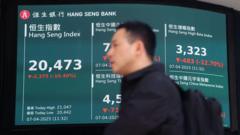
In a dramatic opening on Monday, major Asian markets saw steep declines as repercussions from US tariffs rippled through the region, leading analysts to characterize the situation as a "bloodbath." Investors in markets from Shanghai to Tokyo faced a wave of panic as the Nikkei 225 index in Japan dropped by 6%, while the Australian ASX 200 and South Korea's Kospi fell by 4% and 4.7%, respectively.The situation intensified as mainland markets in China, along with Hong Kong and Taiwan experienced substantial downward pressure. The Shanghai Composite index plummeted over 6%, with the Hong Kong Hang Seng and the Taiwan Weighted Index diving nearly 10%. Analysts note that many of these losses were exacerbated by market closures for public holidays, causing investors to react sharply to negative trends observed in other markets.Market experts have pointed to increasing fears regarding inflation and a potential recession fueled by the tariffs. Goldman Sachs has upgraded its forecast predicting a 45% chance of a US recession within the next year — an increase from 35%. Other firms, including JPMorgan, have similarly raised their odds of a US and global recession to 60%.The heightened tariffs posed by the US are hitting Asian economies the hardest, particularly due to their heavy reliance on exports to the United States. Countries like Vietnam and Bangladesh have become increasingly dependent on the US market for exports, making them vulnerable to tariff hikes which include tariffs of 46% on Vietnam and 37% on Bangladesh announced last week. Major US brands like Nike and Lululemon utilize Vietnam for production, while Bangladesh exports $8.4 billion worth of garments to the US annually.Economists predict that these developments will lead to long-term negative impacts on the global economy, particularly for smaller open economies in Asia. Frank Lavin, former Undersecretary for International Trade, stressed that Asia's economy faces disproportionate challenges due to its export dependence on the US compared to other regions.The situation escalated last Friday when China retaliated against the US tariffs, further intensifying the global stock market decline. The fallout saw major US indexes dropping more than 5% and significant losses across European markets as well, with the FTSE 100 in the UK experiencing its worst decline in five years.As markets brace for further uncertainty, analysts predict that the global stock rout will continue, with US futures trading lower indicating additional challenges ahead for Wall Street.

