In brief
In her latest interview, Anna Wintour navigates her iconic persona, the realities of the fashion world, and her vision for Vogue's future.
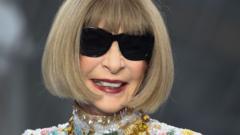
In a dimly lit underground venue at the VOGUE: Inventing the Runway exhibition in London, I meet the iconic Anna Wintour, renowned as the editor-in-chief of Vogue magazine since 1988. Sporting her signature sunglasses, she welcomes me with an enigmatic smile. When I inquire about her dark glasses, she explains, “They help me see and they help me not see. They are a prop,” disguising her true intentions and perhaps shielding her from scrutiny. The exhibition, a lavish celebration of the catwalk's history, captivates guests through high-tech digital projections and immersive audio experiences, showcasing Vogue’s extensive archive. Wintour confesses that after attending countless shows, one can easily become accustomed to the grandeur, but she is excited to offer this unique experience to those who may not have had the opportunity to witness fashion’s most coveted moments live.Reflecting on her long-standing reign in an industry that thrives on immediacy and spectacle, Wintour recalls moments of punctuality amid the notoriously late fashion shows; the American designer Marc Jacobs once delayed a runway event by an hour and a half—much to the irritation of attendees. In contrast, Gianni Versace rarely made excuses for tardiness, arriving on time regardless of who may have been absent.Nostalgia permeates the exhibition as visitors experience a narrative driven by Cate Blanchett. They’ll see everything from Vogue’s early front covers to black-and-white footage of fashion’s roots, highlighting the significant evolution of the industry. Wintour notes the evolution from an exclusive sphere—where attendance was limited to a select few—to a democratic environment where global icons, like Pharrell Williams, can now present collections to mass viewership.The late Karl Lagerfeld is also remembered fondly, especially his visionary concepts that pushed boundaries, including fashion shows in breathtaking locations like the Great Wall of China. His innovative spirit is parallel to Wintour’s, who has played a pivotal role in bridging fashion with popular culture, particularly through events such as the Met Gala, where glamour and celebrity converge.While some view her through the lens of the tyrannical character Miranda Priestly from *The Devil Wears Prada*, Wintour remains unfazed by the comparisons, believing such portrayals depend on a broader interpretation of her persona. Her focus remains firmly on creative endeavors rather than public perception. On a lighter note, Wintour denies the notion that "no one says no" to her—a phrase echoed by industry insiders. “No is a wonderful word,” she insists, emphasizing the importance of balancing power dynamics in the creative process. Despite her formidable presence, Wintour expresses hope that she is not feared, citing the transformative power of fashion as a thriving industry rather than a superficial existence. The magazine, under her guidance, is positioned as a guiding light in an era dominated by social media and influencers.As she embarks on her next chapter, Wintour dispels retirement rumors: “I have no plans to leave my job. Currently.” The engaging exhibition *VOGUE: Inventing the Runway* will be on view at Lightroom in London until April 2025, offering a glimpse into the colorful world of fashion, anchored by the vision of its most illustrious figure.