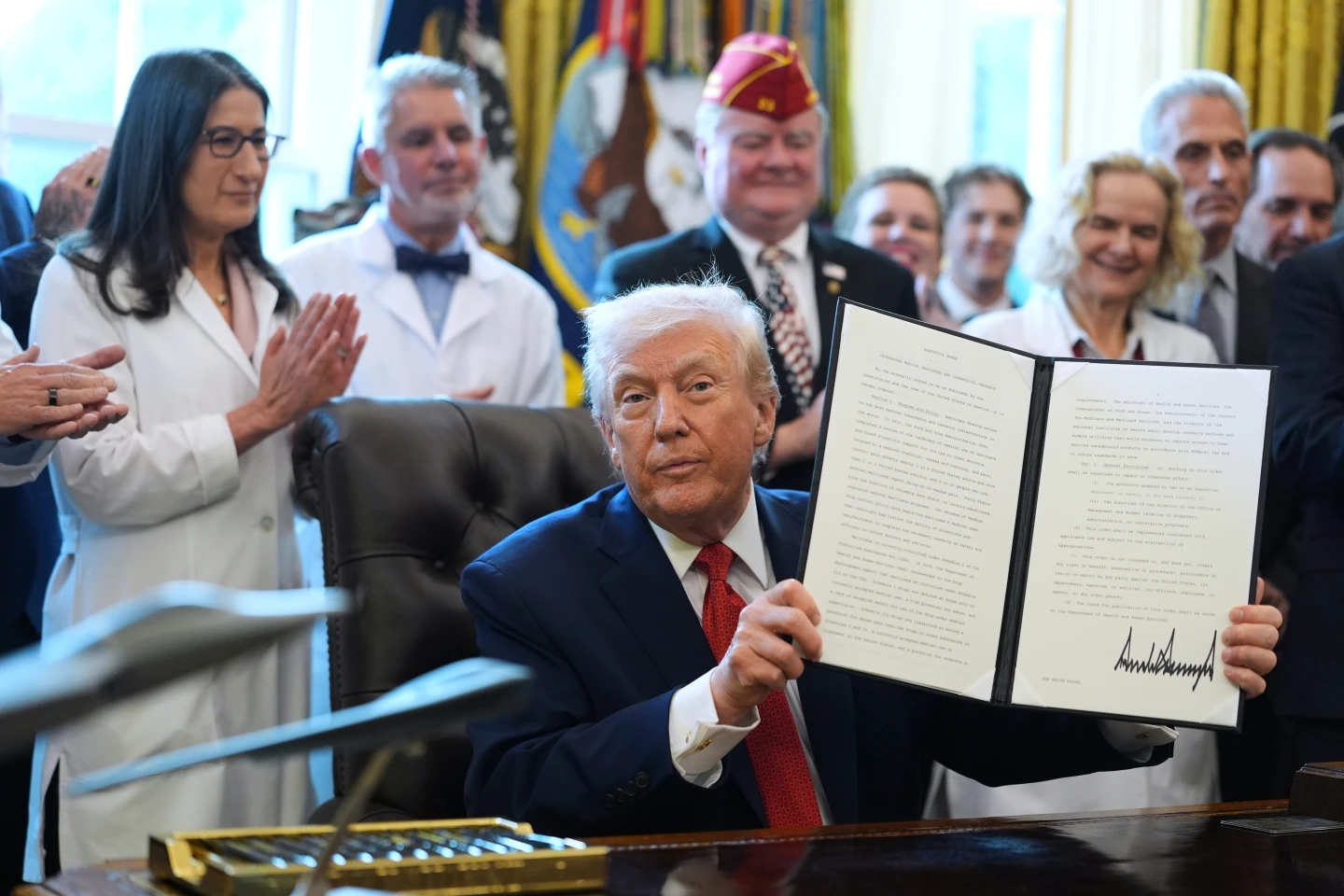
WASHINGTON (AP) — President Donald Trump signed an executive order Thursday that could reclassify marijuana as a less dangerous drug and open new avenues for medical research, marking a significant change in federal drug policy that brings it closer to the stance of many states.
The proposed reclassification would demote marijuana from its current classification as a Schedule I drug to a Schedule III substance, similar to ketamine and some anabolic steroids. While this switch would not legalize recreational marijuana use across the nation, it could change how the drug is regulated, potentially lowering the tax burden on the cannabis industry.
President Trump indicated strong public support for the change, stating, “We have people begging for me to do this. People that are in great pain.”
Previously, the Justice Department under Trump’s Democratic predecessor, Joe Biden, also proposed reclassifying marijuana. However, Trump has not received the same level of bipartisan support for this initiative. Some Republicans have voiced opposition and urged the president to keep marijuana a Schedule I drug, citing health concerns.
The reclassification process is typically lengthy and requires public comment. However, Trump's order aims to expedite this timeline, though it is unclear how soon changes may take effect.
Despite marijuana’s contentious status at the federal level, an increasing number of states have legalized it for recreational or medical use. Public opinion has also shifted significantly, with a Gallup poll showing support for marijuana legalization rising from 36% in 2005 to 68% in 2022.
Trump's order also includes provisions for expanded research into CBD, a legal hemp-derived product. Additionally, a new Medicare program would potentially allow older adults to access CBD products at no cost, contingent on a doctor’s recommendation.
The push for marijuana's reclassification has elicited varied reactions. More than 20 Republican senators argued against the move in a letter to Trump, citing concerns over marijuana's safety and negative impacts on health and public safety.
Trump had previously avoided committing to a complete decriminalization of marijuana, though he indicated it should remain a state-by-state issue during his campaign. His administration continues to emphasize strict action against other drugs, particularly fentanyl, which he has classified as a weapon of mass destruction. The recent executive order is a notable step in a broader conversation about drug policy and public health in the United States.
The proposed reclassification would demote marijuana from its current classification as a Schedule I drug to a Schedule III substance, similar to ketamine and some anabolic steroids. While this switch would not legalize recreational marijuana use across the nation, it could change how the drug is regulated, potentially lowering the tax burden on the cannabis industry.
President Trump indicated strong public support for the change, stating, “We have people begging for me to do this. People that are in great pain.”
Previously, the Justice Department under Trump’s Democratic predecessor, Joe Biden, also proposed reclassifying marijuana. However, Trump has not received the same level of bipartisan support for this initiative. Some Republicans have voiced opposition and urged the president to keep marijuana a Schedule I drug, citing health concerns.
The reclassification process is typically lengthy and requires public comment. However, Trump's order aims to expedite this timeline, though it is unclear how soon changes may take effect.
Despite marijuana’s contentious status at the federal level, an increasing number of states have legalized it for recreational or medical use. Public opinion has also shifted significantly, with a Gallup poll showing support for marijuana legalization rising from 36% in 2005 to 68% in 2022.
Trump's order also includes provisions for expanded research into CBD, a legal hemp-derived product. Additionally, a new Medicare program would potentially allow older adults to access CBD products at no cost, contingent on a doctor’s recommendation.
The push for marijuana's reclassification has elicited varied reactions. More than 20 Republican senators argued against the move in a letter to Trump, citing concerns over marijuana's safety and negative impacts on health and public safety.
Trump had previously avoided committing to a complete decriminalization of marijuana, though he indicated it should remain a state-by-state issue during his campaign. His administration continues to emphasize strict action against other drugs, particularly fentanyl, which he has classified as a weapon of mass destruction. The recent executive order is a notable step in a broader conversation about drug policy and public health in the United States.